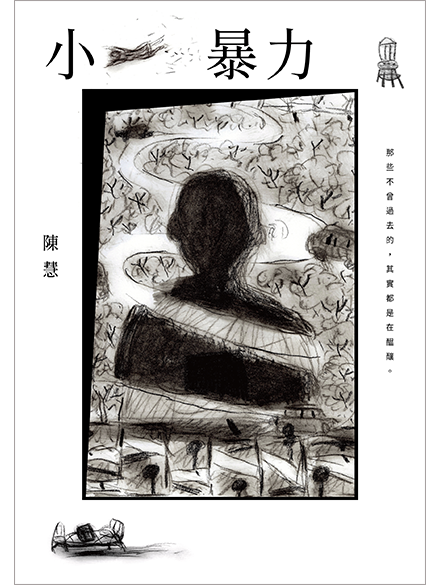
Taking its cue from Edward Yang’s 1986 dramatic film Terrorizers, Chan Wai in Trivial Acts of Violence casts chillingly dispassionate light on the issue of everyday acts of violence across a collection of intertwined narratives spanning Taiwan and Hong Kong.
Trivial Acts of Violence is Taiwan Literature Golden Award-winning author Chan Wai’s first work set primarily in Taiwan. Inspired by the 1986 film Terrorizers, the various narrative threads in this work unfold in Taiwan and Hong Kong in 2020, creating a story that, while paying homage to that earlier film, blazes a trail all its own.
The story opens on a police raid of a bacchanalian party held at the home of a local drug kingpin. An-an, a teen infatuated with the kingpin, who brings him home just before the raid, is arrested after a violent confrontation with the officers but soon released unconditionally after a call from his father, a senior government official. Facing his father’s wrath, An-an maps out a way to skip town through an ingenious scheme involving a family heirloom and an author with a secret. Taipei, in the grips of the COVID-19 pandemic and seething with disruptive, dark energy beneath its deceptively placid surface, sends a muddle-headed youth, maverick police detective, enigmatic author, and the son of a mafia boss inexorably into the same orbit.
The complicated narratives, which jump between Taipei, Hualien, and Hong Kong, are connected through the various forms of violence portrayed in each. Will the protagonists be able to recapture their former peace-of-mind or be forever condemned to the web of violence in which they are entangled?
Chan Wai turns her discerning and dispassionate microscope on modern society, examining the shady influence of power, the legacy of anti-authoritarian street protests, the shameless tit-for-tat relations between public officials and academia, and the dark, pervasive shadow of the pandemic. While some readers may find the “current affairs” flavor of these stories a bit “run of the mill”, the author’s style and pacing encourage readers to reconsider the true substance of “violence” and, in doing so, find new hope for redemption.