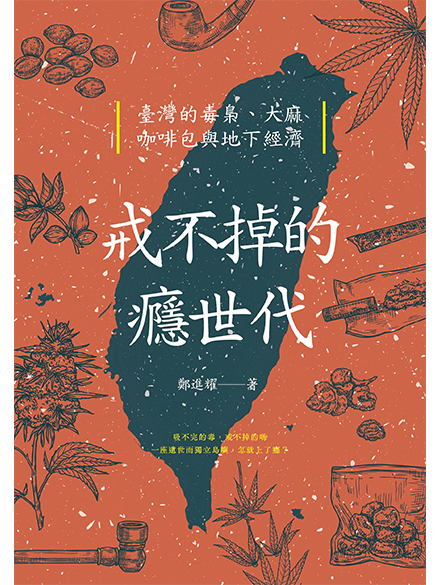
Equal parts in-the-trenches reportage and sociological inquiry, this new account of the illicit drug use in Taiwan challenges traditional approaches that treat addiction as a crime.
Solutions to the drug problem in Taiwan have long been hampered by simplistic approaches that view drug use as a moral failing and a criminal issue. Questioning this logic, Can't Quit goes straight to the source, using interviews and field research to paint a complex portrait of drug use that defies categorical judgements of right and wrong. In this novel analysis, drug use is not simply a legal issue. It's a problem whose origins are embedded in the very structure of contemporary society.
Divided into three parts – "The Sea", "The City", and "The Web" – the book begins with the history of Taiwan's position as a node in the maritime flow of narcotics through Asia. Moving to ""The City"", the book looks at the drug stores, night clubs, and middle-class drug users of the contemporary metropolis. Finally, "The Web" reveals the role of the dark web and social media in exposing people to drugs. From cold syrup to narcotics smuggled in instant coffee packets, from musicians to construction workers, author Cheng Chin-Yao introduces readers to the invisible drug problem that exists right under our noses. When it comes to users, these aren't drug-addled madmen or narco kingpins; they are ordinary people quietly slipping through the cracks of the system.
Adopting an objective and non-judgmental view, author Cheng Chin-Yao enters juvenile detention facilities, prisons, work sites, nightlife districts, and rehabilitation facilities, recording the life stories of addicts from a range of backgrounds. When did they first come into contact with illicit drugs? Why do they feel the need to use? How could society and the system have better served them? Rather than confront drug users with the question "Why can't you just quit?", the author instead confronts readers with the question "What labels have we imposed on drug users, and why?"
This human-centered account of contemporary drug use in Taiwan is equally a sketch of a system that perpetuates drug abuse, revealing that addiction is not the result of individual bad decisions – rather it is the result of systemic factors rooted in the history, culture, medical systems, and economics of contemporary society.