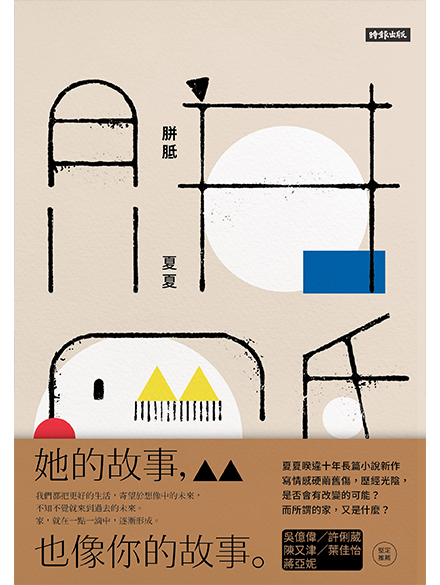
An apology letter from an ex-boyfriend disrupts the quiet life of a housewife, forcing her to revisit her past and reevaluate her present: a life of “calluses” formed by the responsibilities of motherhood, economic pressures, and the friction of cohabiting with her in-laws.
A decade in the making, Calluses is a powerful new novel about the life of an ordinary woman from celebrated author Xia Xia. Written with characteristic nuance and restraint, the novel offers its title as a metaphor for longstanding inner tensions that cannot be resolved, and thus can only be ignored until they slowly harden over, forming a layer of protection that is inseparable from the sense of self.
The arrival of an unexpected apology from Ayi, an old flame, stirs emotions that housewife Chiu-lien had assumed were long settled away in the recesses of memory. It was just a short affair, ten years past. At the time, Chiu-lien hardly knew a thing about life. She didn’t know how to cook, much less how to manage her finances, but she had been more than capable of losing herself in love, starved for any scrap of affirmation from the cool and detached Ayi. Now, wife to a good-natured husband and mother to a young daughter, Chiu-lien leads an ordinary and ordered life, lodging with her in-laws as she frets over when her small family will be able to afford a home of their own.
Through the lens of Chiu-lien’s life, Xia Xia clarifies the common dilemmas of contemporary women: wanting to work, but forced to stay home and raise children; longing for independence, but forever reliant on the financial assistance of parents and in-laws; starved for quality time with a working husband who only comes home on the weekends; always compromising one’s ideals to practicality. The novel’s ultra-realism is composed of layered details that convey the texture of everyday life. From the familiar weight of the baby stroller, to the gossip shared with other mothers at the park, to household quarrels over the dripping AC unit, every trivial fragment is imbued with deeper hopes and anxieties.
With the incisiveness of a poet, Xia Xia captures the loneliness and warmth of urban life, distilling literature from our contemporary dilemmas and probing the potential for meaning within a quotidian existence. Under Xia Xia’s pen, the wounds of everyday living are washed and aired by time, scabs form, skin heals, and, finally, new energy is found to meet the days ahead.