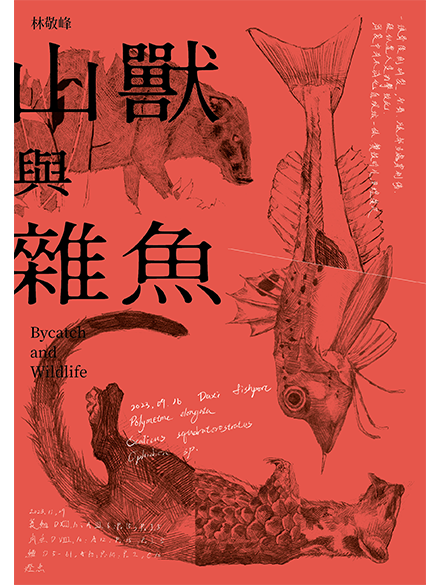
Wildlife spotting, rummaging through harbor bycatch for fish specimens, fixing meals in his “no flames allowed” dorm room, and preparing specimens in a natural history museum are all part of the extracurricular “everyday” for this set design student. Disparate fields and pastimes intertwine effortlessly in Lin Jing-Feng’s essays.
Apart from building models, familiarizing himself with “the theater”, reading scripts, and hanging with his dormmates, theatrical costume design student Lin pursues another life – far off the expected script. He regularly takes off into the mountains, trekking lonely trails, walking wild streams, observing ants, and making fish and wild animal specimens with another school’s zoology department. He also dallies around fishing harbors, sifting through the bycatch delivered from fixed net fisheries.
The four sections in Bycatch and Wildlife, The Beginning, The Great Outdoors, The Sea, and Knives, include over thirty essays interspersed with the author’s own scientific illustration-like drawings. “The Beginning” opens on a narrative-framing conversation the author has in an izakaya. “The Great Outdoors” touches on the author’s encounters and observations of mountain boar, pangolins, bats, ants and other wildlife. “The Sea” shares his adventures searching for interesting specimens among harbor bycatch and noteworthy experiences cooking meals in his makeshift dorm kitchen. The final section, “Knives”, explores how sharp scalpels and animal carcasses can create emotively soul-searching dialogues.
Straddling the realms of the humanities and natural sciences, author Lin Jing-Feng invests his singular knack for science communication into ongoing dialogues with nature and its myriad of creatures. His lively writing style vitalizes his thoughts on a wide range of subjects, turning even the “mundane” into topics worth examining and exploring further.