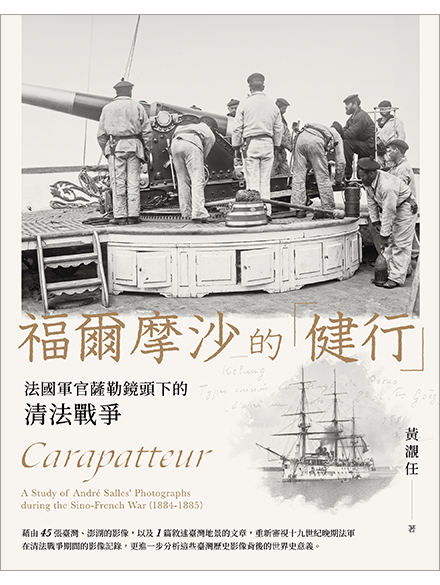
During his sojourn on Formosa (Taiwan) during the Sino-French War, French naval officer André Salles made a personal record of the island’s people and sights in photographs. Different from typical “war photography”, these images reflect Salles’ impressions of late nineteenth-century Taiwan and his inquisitiveness about exotic lands and cultures.
In 1884, France expanded its war with the Chinese Empire over sovereignty in Indochina to the island of Taiwan, hoping to make it a bargaining chip in eventual peace negotiations. After several failed attempts to capture Tamsui, the French briefly occupied the northern port town of Keelung and the Pescadore (Penghu) Archipelago before abandoning the venture altogether. Today, France’s military interlude on Taiwan is an important topic of academic interest and study. Carapatteur centers around forty-five photographs taken by French officer André Salles while on Taiwan and the Pescadores in 1884 and 1885, exploring contemporary cultural and natural landscapes as well as Salle’s motivations and photographic approach.
Noble-born and educated, it is likely Salles enlisted in the navy out of a dual sense of patriotism and eagerness to see the world. As a French Alpine Club member, he published some of his photographs as engraved prints along with descriptions of the highlands of northern Formosa (Taiwan) in their journal, The Alpine Club Annual.
Included among the forty-five photographs are pictures of French forces firing cannon from a hilltop stronghold, soldiers and civilians posed by a temple gate, and a captive fisherman posed next to a battleship gun. Many of the images seem to have been taken while off-duty and often portray scenes at odds with France’s status as a hostile occupation force. Always off-camera, Salles captures the complex face of the French occupation and the fact that, although fighting to extend and secure France’s colonial empire, not all soldiers were wholly comfortable with their imperialist mission.
Drawing on rigorous historical research and data as well as insights into the thoughts and thinking of those invested in France’s colonial mission, this book packs exceptionally reprinted photographs and insightful, engaging prose. Readers see the limitations imposed on individuals caught in the flow of history, and how victories, defeats, transformative events, and political ideologies spring from a complex, and very human, polity.