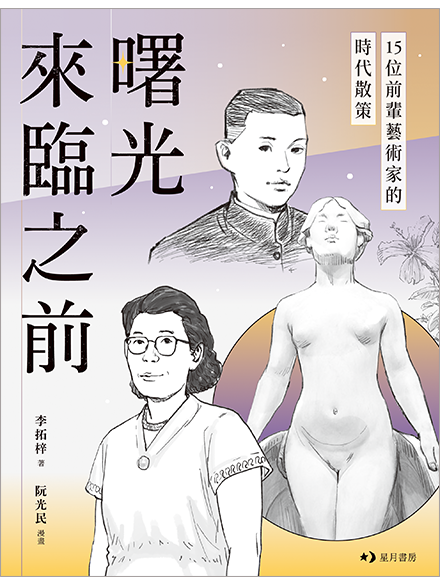
This book tackles the stories and backstories of fifteen Taiwanese artists living and creating under colonial and then Martial Law rules and restraints. Working during this “dark age” of domestic creativity and artistic expression, the lonely but vital path they blazed makes them the progenitors of today’s prolific creativity.
As Taiwan’s reputation for artistic innovation and creativity continues to rise both at home and abroad, authors are wading in to tell the story of the history of modern art on the island. In Before the Dawn, Lee Tuo-Tzu invests his authorial skills as a former political speechwriter to frame stories of formative local artists of the early and mid-twentieth century within the context of contemporary political pressures and influences, showing how they and their work stealthily and effectively cut against the current to foster hope in the future.
The book opens on Huang Tu-Shui (1895-1930), a talented sculptor working in the 1920s with dreams his art would secure his indelible reputation in East Asian art circles. However, most of his works vanished in the chaotic postwar years. As a Taiwanese artist working in colonial Japan, Huang’s legacy was ignored and underappreciated until Water of Immortality, featured at the 1921 Imperial Art Exhibition in Tokyo, resurfaced in 2021. Its return to public awareness marked a watershed moment in the recognition and visibility of Taiwan art.
Many of the other artists covered in this work are contemporaries of Huang, including Li Mei-shu, an oil painter who invested much effort in supervising the restoration of his hometown temple, social activist Chen Chih-chi, and Chen Cheng-po, a victim of summary execution by KMT soldiers during the (1947) 228 Incident. Late-colonial period artists also featured include Chen Chin, Lin Yu-shan, and Kuo Hsueh-hu – three painters known for their works in the “Eastern gouache” genre. The innovations and education they and their contemporaries brought to the island’s art scene helped fuel steady, subtle resistance to autocratic rule.
Standalone stories in each chapter are fronted by two-page narrative comic strips drawn by popular comic strip artist Ruan Guang-Min. Centered around a fictional high school art student learning about these prewar artists, these strips open another window into their life and times.