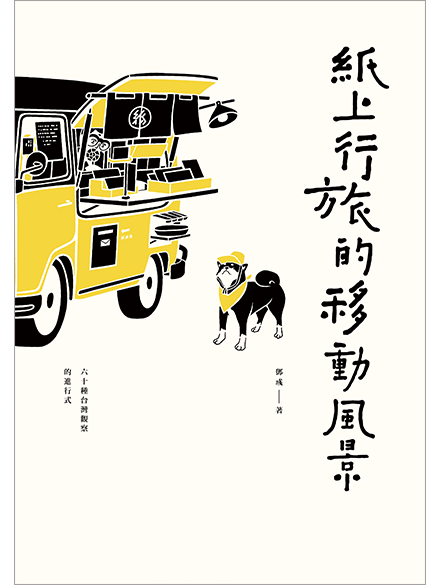
In this homage to ordinary people’s hard work, sixty meticulously rendered illustrations reminiscent of block prints capture everyday scenes of Taiwan’s street vendors, showcasing life’s beauty and a human sensibility unique to the island.
Illustrator Teng Yu has an eye for wheels. Teng’s close observation of them and what sits on top were the starting point for this book, which presents a microcosm of hard-working street vendors. The illustrations, rendered in simple colors and paired with short passages of text, capture everyday scenes of Taiwanese street vendors and their carts in action, giving these vendors’ work ethic its due.
The book’s cover features the author’s vehicle and canine companion – a yellow vending truck with stationery for sale and a black Shiba Inu. While flipping through the book, readers will discover that the Shiba Inu and the author’s alter-ego (wearing black glasses, a black shirt, and seven-quarter pants) appear throughout, accompanied by an assortment of vending carts.
The book’s sixty illustrations are divided into four sections, each of which highlights a type of wheeled transportation popular with street vendors: “Pushing Territory” covers the simple hand cart; “The Pedaling Life” presents bicycle and tricycle vending carts; “Scooting Round the World” introduces the various motorbike food carts ubiquitous in Taiwan ; and “Wheels for Four Seasons” features that most luxurious of street vendor vehicles, the minitruck. Some of the vendors sell cotton candy or iced tea ; some offer freshly cooked wheel cakes; others hawk window screen repairs or quietly collect recyclables.
The author, who enjoys wood carving and printmaking, prefers to create images through the use of simple lines and colors. Accordingly, Teng often depicts the typically colorful vending carts with six colors or fewer. The most frequently used color is black, a clear sign of Teng’s interest in printmaking. Profoundly characteristic of the author’s personal style, the illustrations offer many surprising details gathered from Teng’s careful observation of vending carts. The book could be called a perfect combination of scenes from ordinary Taiwanese people’s lives and literate, artistic creativity.