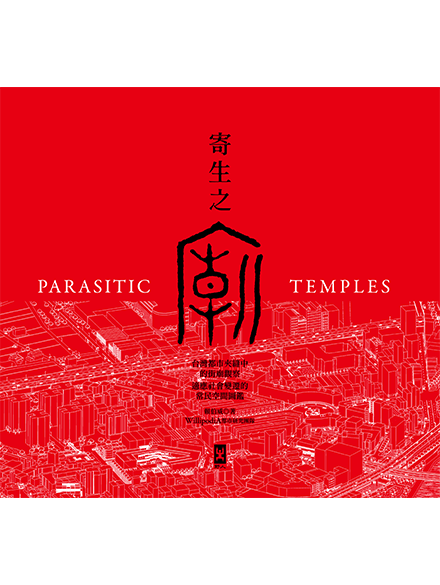
Taiwan’s diverse religious beliefs have resulted in not just big, square temples, but also many smaller ones wedged into urban crevices. After architects from across Taiwan went in search of these unusual places of worship, a famous architect recorded over a hundred temples that have merged with their surroundings.
In 2010, Lai Po-Wei discovered a long, narrow temple under a Taipei flyover, wedged between an adjacent levee and another building. He later noticed many more of these “parasitic temples” on odd-sized lots in unexpected places – urban corners, the underside of bridges, markets, apartment buildings, and even sidewalks. So he and a group of colleagues began to keep observation records. Ultimately, he documented the Taiwanese urban worship spaces they found in this illustrated guide.
A blend of architecture, urban observation, and cultural narrative, this book borrows biological taxonomy to describe 108 manifestations of the “informal architecture” typical of Taiwanese temples. Thirty-six of the most representative “parasitic temples” are presented, each introduced with its classification, pictograms of structural attributes, and a site drawing. Each entry describes the temple’s construction and shows how it has survived, made compromises, and evolved in the midst of urban development: a temple built beside a levee was subsequently converted to a structure that can be raised and lowered like an elevator to protect it from floods; another is hidden in an ordinary parking lot; one hangs in mid-air, straddling an entire street; and one was built on a hand cart, allowing it to be moved at any time to avoid eviction for breaking the law, just like a mobile vending stall!
Most of the parasitic temples defy common sense or are even illegal, but they are full of grassroots creativity inspired by the beliefs of the craftsmen who built them. This book is an objective record of the organic relationship between parasitic temples and their hosts. It preserves these fascinating, precious cultural specimens that represent the spiritual landscape in the midst of urban change.