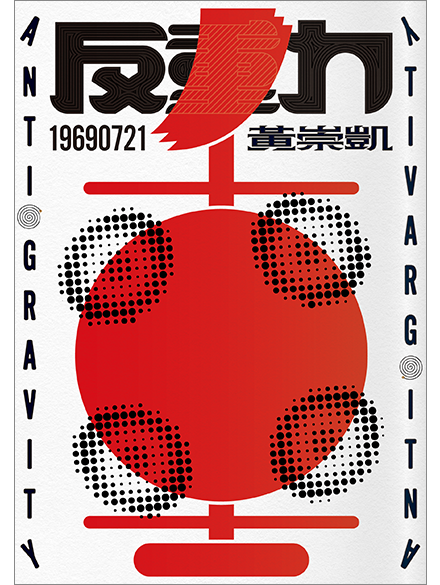
* 2025 Golden Tripod Award
There are two kinds of gravity. One is natural, and by opposing it, men take to the heavens. The other is authority, and by opposing it, men land in jail. Set during the political oppression of the White Terror, this collage of multiple viewpoints is a fictionalized history of Taiwan's struggle for democracy.
Set against the backdrop of the White Terror in 1970's Taiwan, Anti-Gravity incorporates numerous historical persons into fictional portraits of individuals fighting for democracy under conditions of harsh authoritarian rule – a struggle akin to fighting against gravity.
American astronaut and first-man-on-the-moon Neil Armstrong visits Taiwan during the Chiang Kai-shek regime, and has a brief meeting with a man known as ""the old general"" who is living under house arrest. This encounter has ramifications that seem to transcend the bounds of space-time, changing both men. The old general's minder, a man called Horseface, is repulsed by the system he serves, but finds comfort in the fantastic imagery of the sci-fi classic 2001, and in the opportunity to discuss the film with Armstrong.
Pursuing their political ideals, students Paolo and A-Chi choose to study abroad in the US, where they are swept up in the civil rights movement and the political revolutions in South America. As they keep tabs on politics in Taiwan from abroad, their conversations gradually reveal inside knowledge of the 1970 assassination attempt on Taiwanese Vice Premier Chiang Ching-kuo during his visit to the US.
Meanwhile, a college professor and the political dissident Hsu I-wen, endure years of imprisonment and surveillance. The professor eventually flees Taiwan using a fake Japanese passport, causing a major loss of face for Taiwan's secret security apparatus, and Horseface's colleague is demoted during the fallout. While Hsu I-wen serves out his twenty-five-year sentence, some of his fellow prisoners pay for their commitment to Taiwan's independence with their lives.
Momentous political changes inform the background of these stories: the re-kindling of diplomatic relations between the US and communist China, Taiwan's forced withdrawal from the UN, and the Taiwanese people's struggles during the slow process of democratization. Throughout, the space program and the moon landing act as powerful metaphors for progress and hope in the future – the freedom of the weightlessness standing in contrast to the crushing weight of state control. Completed by the author during his time as Artist-in-Residence at Taiwan's National Human Rights Museum, the novel weaves multiple fictional narratives through the weft of Taiwan's political history, depicting oppression and resistance under authoritarian rule. Even as their fates are restricted by the historical times, in their struggle for freedom, the characters in these stories play a role in shifting the axis of history, leaving an impact on the generations that follow.