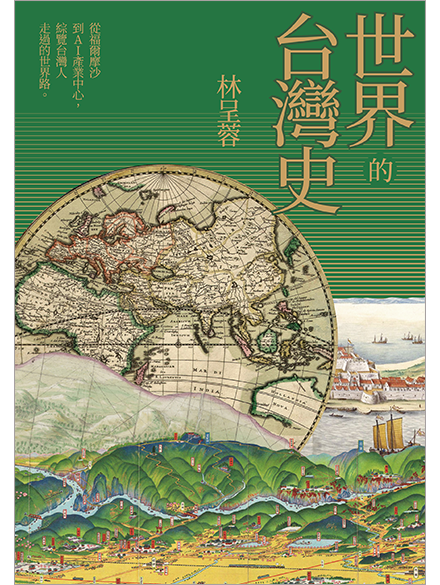
Situated on a key shipping route, Taiwan has been a hub for the exchange of people and goods since ancient times. This book looks at Taiwan’s role in world history from a maritime perspective, as well as the historical reasons for Taiwan’s current multifaceted society and influence on world affairs.
Taiwan has had many names: “Dongfan” was one of several used by the Chinese in the sixteenth century. After Portuguese sailors passed through the island around 1542, the most common name on world maps became “Ilha Formosa”. In the seventeenth century, the Dutch used “Tayovan”, while “Kōzankoku” appears in Japanese documents of the same period. To this day, scholars remain unsure of the origin of “Taiwan”, each theory indirectly confirming the complexity of Taiwan’s history, with the only certainty being that the island has had a role in world history from very early on. This book provides a fascinating historical account of Taiwan’s global interactions.
Divided into thirteen chapters and a conclusion, the book begins with prehistoric artifacts from trade exchanges. It next moves to the Age of Exploration, a period of recorded history in which commerce flourished, and then to the nineteenth century, when European and American powers competed for an Asian presence and established bases in Taiwan. It continues with the Japanese colonial period, which introduced the basic education and infrastructure of today, and concludes with the diplomatic and economic activities that enabled participation in international affairs after the lifting of martial law. These chapters show how the island’s residents gradually transitioned from passive acceptance of outside influence to active engagement with the world.
Professor Lin condenses Taiwan’s history into a compact book that is both concise and extraordinarily informative. A World History of Taiwan explains how the Taiwanese people have been able to embrace their diversity and limitations to turn their island home into a place full of opportunities, despite its small area and the frequent external challenges it has had to confront.